Looking for a Xero Alternative in Ireland? What Small Businesses Should Consider (2026)
· By MyLedgerBook Editorial Team
Updated September 2026 · Pricing and features checked September 2026
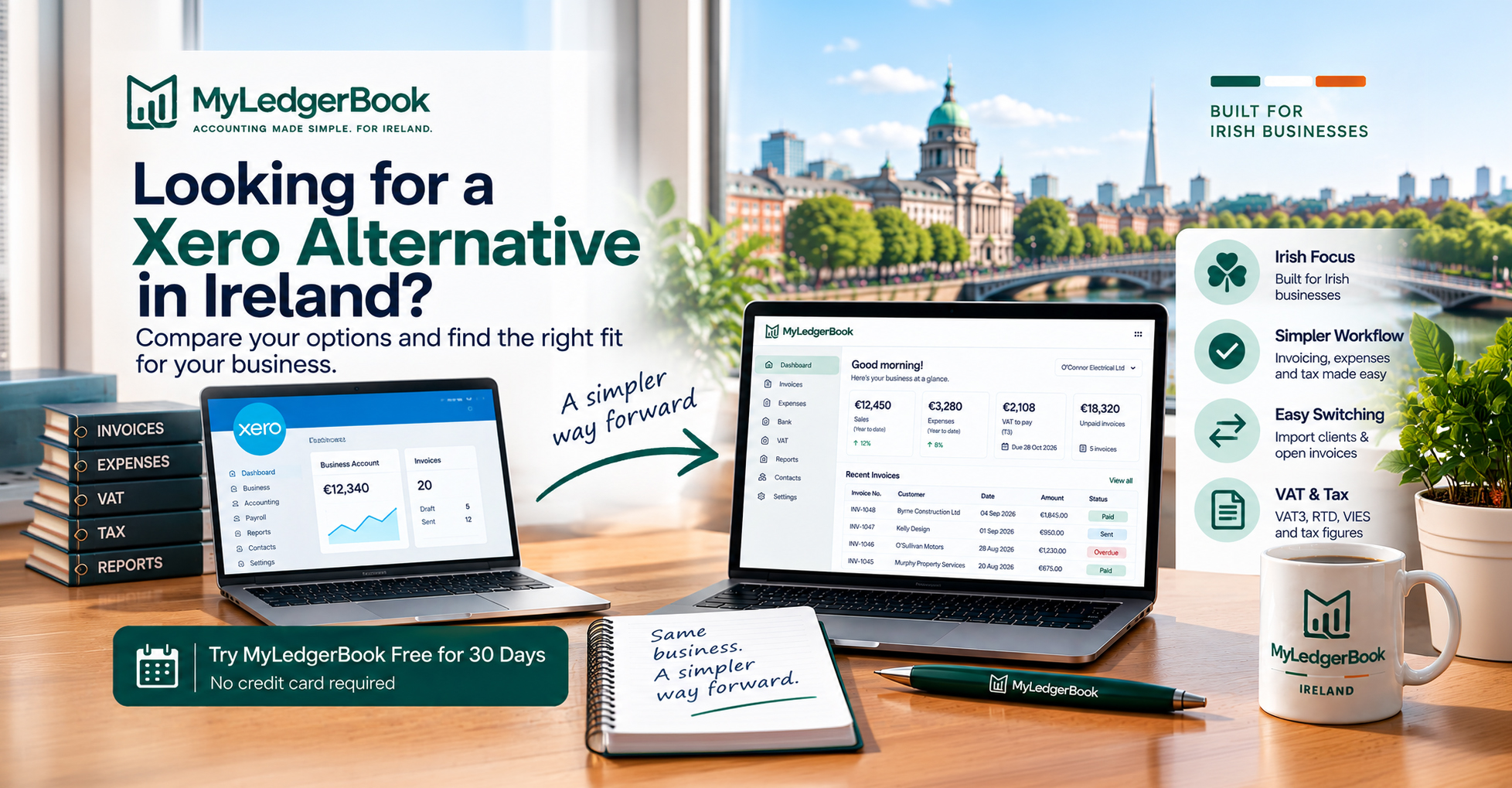
Xero is one of the best-known cloud accounting platforms available to Irish businesses.
It offers invoicing, bank reconciliation, bills, reporting, document capture, projects, inventory, integrations and many other accounting features.
For plenty of businesses, that's exactly what they need.
But it doesn't automatically mean Xero is the right accounting software for every sole trader or small business in Ireland.
If you're searching for a Xero alternative in Ireland, the important question isn't simply:
"What software is cheaper than Xero?"
A better question is:
"What accounting software actually fits the way my Irish business works?"
Quick answer: Xero is a powerful accounting platform and may be an excellent choice for businesses that need its broader accounting ecosystem. Smaller Irish businesses looking for an alternative should compare simplicity, Irish VAT and tax support, invoicing, expenses, accountant access, data ownership, migration options and the real subscription cost. The best alternative is the one that gives your business the functionality it actually needs without unnecessary complexity.
Why do Irish businesses use Xero?
There are good reasons Xero has become popular.
Xero says more than five million customers use its platform globally, and its accounting software provides a broad range of functionality.
Depending on the plan and additional services required, Xero can provide features including:
- invoicing and quotes
- bills
- bank reconciliation
- online payments
- financial reporting
- document capture
- expense management
- projects
- inventory
- purchase orders
- fixed assets
- multi-currency accounting
- cash-flow forecasting
- mobile apps
- integrations with other business software
For a growing company that wants a broad accounting ecosystem, that can be extremely useful.
Xero also has widespread familiarity among accountants and bookkeepers.
So this isn't an argument that Xero is bad accounting software.
It isn't.
The question is whether your particular business needs that breadth of functionality.
Why might a small Irish business look for a Xero alternative?
Businesses change accounting systems for different reasons.
You might be looking for:
- something simpler
- software more focused on Ireland
- a different pricing model
- fewer restrictions at entry level
- clearer Irish VAT information
- easier tax visibility
- a less complicated interface
- easier switching
- functionality better suited to a sole trader
- functionality better suited to a small limited company
Sometimes businesses also discover that they are paying for a large accounting platform while using only a small part of it.
If your workflow is mainly:
Send invoices
↓
Record expenses
↓
Keep receipts
↓
Track what customers owe
↓
Prepare VAT and tax figures
then it is reasonable to ask whether you need a much broader accounting system.
How much does Xero cost in Ireland in 2026?
As of 9 September 2026, Xero's Irish website lists three principal plans:
Starter — $29 per month
Standard — $50 per month
Premium — $75 per month
These are the regular prices shown after Xero's current introductory offer.
Xero currently prices these Irish subscriptions in US dollars rather than euro.
The company also states that its subscription prices will change from 1 November 2026, so businesses considering Xero should check the latest price directly before subscribing.
Promotional discounts can also change, so compare the ongoing subscription price rather than making a decision based only on the introductory rate.
Does Xero Starter have limits?
Yes.
As of September 2026, Xero's Starter plan allows users to:
- send quotes
- send up to 20 invoices
- enter up to 5 bills
- reconcile bank transactions
- use Smart Document Capture
- access reports
- use a 30-day cash-flow forecast
For more than 20 invoices, Xero directs customers towards its Standard plan.
That doesn't necessarily matter to a very small business.
But consider your actual transaction volume.
If you issue:
5 invoices each month
20 invoices may be plenty for some time.
If you issue:
30 or 50 invoices each month
an entry-level invoice limit becomes much more important.
The cheapest advertised plan isn't necessarily the plan your business will actually need.
Is Xero too complicated for a small business?
Not necessarily.
Complexity is subjective.
A bookkeeper using Xero every day may find it extremely straightforward.
Someone running a small landscaping business and opening accounting software twice a week may feel differently.
Recent discussions among Irish small-business users show that simplicity remains an important consideration when choosing bookkeeping software.
Business owners frequently want practical things such as:
- easy invoicing
- receipt organisation
- expenses
- VAT information
- bank information
- accountant access
rather than every possible accounting function.
The right question isn't:
"Does Xero have too many features?"
It is:
"Will I actually use the features I'm paying for?"
What should you compare when looking for a Xero alternative?
Don't compare accounting systems purely by counting features.
Start with your business.
Ask what you actually do every week.
For many Irish sole traders and small companies, the core requirements are:
Invoicing
Can you create professional invoices quickly?
Can you see what's unpaid?
Can you handle deposits or staged invoices if your business needs them?
Expenses
Can you record purchases easily?
Can you attach receipts?
Can you see whether supplier bills have been paid?
VAT
If you're VAT registered, does the software help prepare the information required for Irish VAT?
Tax
Does the system help you understand your tax position rather than simply recording transactions?
Accountant access
Can your accountant work with your records without unnecessary duplication?
Data
Can you export your accounting information if you decide to leave?
Price
What will you actually pay once introductory discounts, limits and optional extras are taken into account?
Simplicity
Most importantly:
Will you actually keep it up to date?
The most sophisticated accounting software in the world isn't much help if you avoid opening it.
For a broader comparison checklist, read our Accounting Software for Small Businesses in Ireland guide.
How important is Irish VAT support?
Very important if you're VAT registered.
Ireland's VAT system involves requirements and terminology such as:
- VAT3
- T1
- T2
- T3
- T4
- RTD
- VIES
- Irish VAT rates
- cash receipts basis
- ROS filing deadlines
Xero provides VAT functionality for Irish businesses.
Its Irish VAT pages explain that users can configure VAT rates, automatically calculate VAT on transactions and use tax reports to prepare information for VAT returns.
That is useful functionality.
When comparing alternatives, however, look beyond whether the product simply says:
"Supports VAT."
Ask how the system represents the Irish VAT information you actually need.
For example:
Can I clearly see the figures I need for my VAT3?
Can I understand where they came from?
What happens when I need my annual RTD?
Does it support VIES if my business needs it?
Our VAT3 Ireland guide explains the Irish VAT3 process in detail.
You can also read our RTD Ireland guide.
What about businesses that aren't VAT registered?
VAT shouldn't dominate your accounting software decision if you're not VAT registered.
Many Irish sole traders operate below the mandatory VAT registration threshold.
Their priorities may instead be:
- invoices
- expenses
- receipts
- profit
- unpaid customers
- tax estimates
- Form 11 information
- deadlines
If that's your situation, software designed around complex VAT workflows may be less important than straightforward everyday bookkeeping.
Our VAT Registration Threshold Ireland guide explains the current Irish VAT thresholds.
What should an Irish sole trader look for instead?
A sole trader usually doesn't have an internal accounts department.
The owner may be:
salesperson + administrator + bookkeeper + person doing the actual work.
That changes what "good accounting software" means.
A sole trader may value being able to open the software and immediately understand:
How much have I invoiced?
Who hasn't paid me?
What have I spent?
How much profit am I making?
What VAT might I owe?
How much should I be keeping aside for tax?
For that user, clarity can be more valuable than a long menu of advanced accounting functions.
See our Sole Trader Accounting in Ireland guide for more on the records and tax responsibilities involved.
What should a small limited company look for?
A limited company may require more accounting structure than a sole trader.
But small limited companies vary enormously.
A consultancy with one director and 20 monthly transactions has very different needs from a company with:
- 30 employees
- multiple departments
- substantial inventory
- international operations
- complex projects
Don't choose software because your business has "Ltd" after its name.
Choose it according to what the company actually does.
A small owner-managed Irish company may still value:
- simple invoicing
- expense recording
- VAT information
- profit visibility
- Corporation Tax figures
- accountant access
- Revenue deadlines
- CRO deadlines
over more sophisticated enterprise functionality.
What about mobile apps?
Xero has dedicated mobile applications for iOS and Android.
That is an advantage if a native mobile app is important to you.
MyLedgerBook currently works on mobile devices through the web browser and can be added to a phone's home screen for quick access, but it does not currently have a dedicated mobile app.
This is a good example of why comparison articles should be realistic.
If having a native accounting app is one of your highest priorities, that may influence your choice.
If your priority is Irish VAT and tax visibility or a simpler accounting workflow, other factors may matter more.
What about bank feeds and integrations?
Xero has a significant advantage here for businesses that need a broad integration ecosystem.
Xero states that it can connect with thousands of financial institutions globally and integrates with more than 1,000 apps.
That can be valuable if your business depends on connections with:
- payment platforms
- ecommerce systems
- inventory tools
- CRM systems
- project management
- specialised industry software
Not every small business needs those integrations.
But if yours does, investigate them carefully before changing software.
Never move to a simpler accounting product and then discover that a critical system you use every day cannot work with it.
Is having more integrations always better?
No.
An integration is valuable when it solves a real problem.
A list of 1,000 integrations doesn't automatically provide more value to a sole trader who uses none of them.
Ask:
Which integrations does my business actually require?
If the answer is three specific services, investigate those three.
Don't choose accounting software because of hundreds of integrations you will never install.
What about payroll?
Payroll is another area where requirements vary significantly.
If you employ staff, establish exactly what payroll functionality you require and whether it is included in the accounting product, provided separately, or requires integration with another service.
MyLedgerBook does not currently provide payroll.
If integrated payroll is essential to your business, take that into account when comparing alternatives.
Being clear about what software doesn't do is just as important as understanding what it does.
Is MyLedgerBook a Xero alternative?
For some Irish small businesses, yes.
But MyLedgerBook isn't trying to reproduce every Xero feature.
That would defeat the purpose.
MyLedgerBook is designed specifically for:
- Irish sole traders
- freelancers
- tradespeople
- owner-managed businesses
- small limited companies
The focus is on making everyday Irish bookkeeping and tax preparation easier.
That includes:
- professional invoicing
- deposits and staged invoices
- customer management
- expenses
- suppliers
- receipt storage
- VAT figures
- VAT3
- RTD
- VIES
- sole-trader Income Tax figures
- Corporation Tax figures
- Revenue deadlines
- CRO deadlines
The objective is:
Enter the transactions you already deal with
↓
MyLedgerBook builds the accounting records
↓
Your Irish VAT and tax figures become easier to prepare and understand
MyLedgerBook does not file Revenue returns for you.
You review the figures and file through ROS yourself or use the information when working with your accountant.
Xero vs MyLedgerBook: what's the difference?
They aren't identical products, and that's important.
Xero may be the better fit if:
You need a broad international accounting platform.
You depend heavily on third-party integrations.
You require advanced inventory or project functionality.
You want a dedicated iOS or Android accounting app.
Your accountant has built their entire workflow around Xero.
You require functionality that MyLedgerBook doesn't currently provide.
MyLedgerBook may be worth considering if:
You run a small Irish business.
You want accounting software built around Irish requirements.
You want invoicing and expenses without unnecessary complexity.
You want your VAT3, RTD and VIES figures prepared from your bookkeeping records.
You want visibility of Irish tax figures and deadlines.
You want to manage multiple businesses under one login.
You want to try the software without entering a credit card.
Neither list makes one product universally better.
It identifies the type of business each approach may suit.
Can you move from Xero without starting again?
This is one of the biggest concerns businesses have about switching.
You may already have:
- hundreds of customers
- unpaid invoices
- years of historical records
- an established invoice sequence
Changing software doesn't mean all of that should disappear.
MyLedgerBook allows you to:
- import your clients
- import your open invoices
- choose the starting number for your invoices
For example, suppose the last invoice issued from Xero is:
Invoice 1847
You can set your MyLedgerBook invoice numbering appropriately so you aren't automatically forced to begin again at invoice 1.
Likewise, importing open invoices allows you to continue tracking money customers already owe after moving.
For the full process, read our How to Switch Accounting Software in Ireland guide.
Do you have to import your entire Xero history?
Not necessarily.
Moving accounting software and retaining accounting records are two different issues.
Irish businesses generally need to retain the records required by Revenue for the appropriate period.
That doesn't automatically mean every old transaction must be recreated inside the new accounting system.
Depending on your circumstances, you might retain historical reports and records from Xero while bringing the information needed to continue operating into the new system.
This could include:
- clients
- open invoices
- opening balances
- VAT position
- other relevant accounting balances
The correct approach depends on your business.
If your accounts are complex or you're moving part-way through an accounting period, discuss the migration with your accountant.
Should you cancel Xero before trying an alternative?
No.
There is little reason to cancel your existing accounting system before you know whether the replacement works for you.
Instead:
Keep your existing system
↓
Try the alternative
↓
Test the everyday workflow
↓
Check the features you actually need
↓
Plan the migration
↓
Verify the new system
↓
Only then consider cancelling the old one
This reduces the risk considerably.
What should you test during a free trial?
Don't spend a free trial simply clicking through menus.
Use it like your actual business.
Try to:
- create your business
- add or import a customer
- create a real-world test invoice
- record an expense
- attach a receipt
- mark an invoice paid
- look at your VAT or tax figures
- check your reports
- see what information can be exported
- try it on your phone
- consider whether your accountant could work with the output
- ask yourself whether you'd actually use it every week
After doing that, you'll know considerably more than you will from comparing feature tables.
Can you try MyLedgerBook before leaving Xero?
Yes.
MyLedgerBook provides a 30-day free trial with no credit card required.
You don't need to cancel Xero or commit to a migration first.
You can create a MyLedgerBook account, explore the software and see whether the workflow suits your business.
If you're considering switching, you can also test bringing across clients and open invoices and configure your invoice numbering appropriately.
Looking for a simpler Irish alternative?
MyLedgerBook is accounting software built in Ireland for Irish small businesses.
Try it alongside your existing accounting system before deciding whether to switch.
30-day free trial · No credit card required
Xero Alternatives Ireland: Frequently Asked Questions
Is Xero good for small businesses in Ireland?
Yes. Xero is a mature cloud accounting platform with substantial functionality and is suitable for many Irish small businesses. Whether it is the best fit for a particular business depends on the features required, transaction volume, integrations, accountant workflow, complexity and budget.
How much does Xero cost in Ireland?
As checked on 9 September 2026, Xero lists regular Irish prices of $29 per month for Starter, $50 for Standard and $75 for Premium after the current introductory offer. Xero prices these plans in USD and has announced subscription price changes from 1 November 2026. Always check Xero's current pricing before purchasing.
Is there an Irish alternative to Xero?
Yes. Several accounting products serve Irish businesses, including Irish-focused and international providers. MyLedgerBook is built in Ireland specifically for Irish sole traders and small businesses and is one option worth considering where its feature set matches the business's requirements.
Does Xero support Irish VAT?
Yes. Xero provides VAT functionality for Irish businesses, including configurable VAT rates, automated VAT calculations and tax reporting that can be used when preparing VAT returns.
Does MyLedgerBook support VAT3?
MyLedgerBook prepares VAT3 figures from the invoices and expenses recorded in the system. It also prepares figures for RTD and VIES where applicable. MyLedgerBook does not file the return with Revenue on your behalf.
Can I move my customers from Xero to MyLedgerBook?
MyLedgerBook allows you to import existing clients rather than manually recreating every customer.
What happens to my unpaid Xero invoices if I switch?
MyLedgerBook allows open invoices to be imported so that you can continue tracking amounts customers already owe. Check the imported balances carefully as part of any migration.
Can I continue my Xero invoice numbering?
MyLedgerBook allows you to choose the starting number for your invoices. This means you can configure your invoice sequence appropriately when moving from another accounting system.
Does MyLedgerBook have a mobile app?
MyLedgerBook does not currently have a dedicated iOS or Android app. The service works through mobile web browsers and can be added to a phone's home screen for convenient access.
Does MyLedgerBook have payroll?
No. MyLedgerBook does not currently provide payroll. Businesses requiring payroll should factor that requirement into their choice of accounting software.
Should I switch from Xero to MyLedgerBook?
That depends on your requirements. If you rely on Xero's wider integrations, advanced functionality or native mobile applications, remaining with Xero may make sense. If you're a smaller Irish business primarily looking for straightforward invoicing, expenses and Irish VAT and tax preparation, it may be worth testing MyLedgerBook before deciding.
Sources and further reading
Product functionality and prices change. The information below was checked on 9 September 2026.
- Xero Ireland — Accounting software
- Xero Ireland — Pricing plans
- Xero Ireland — Accounting features
- Xero Ireland — VAT software
- Xero Ireland — Mobile accounting app
- Revenue — VAT
Last reviewed: 9 September 2026
Pricing, plan limits and product features can change. Check the provider's current website before making a purchasing decision. This guide provides general information and is not tax, accounting or financial advice.