
VAT Registration Threshold Ireland 2026: When Do You Need to Register?
· By MyLedgerBook Editorial Team
Updated September 2026 · Based on current Revenue guidance
Do you need to register for VAT in Ireland? For many sole traders and small businesses, the answer depends on what you sell and your annual turnover.
The important part is that Ireland does not have one single VAT registration threshold for every business. A business supplying services can have a different threshold from a business selling goods, and special rules can apply to mixed businesses, EU purchases, cross-border sales and services received from abroad.
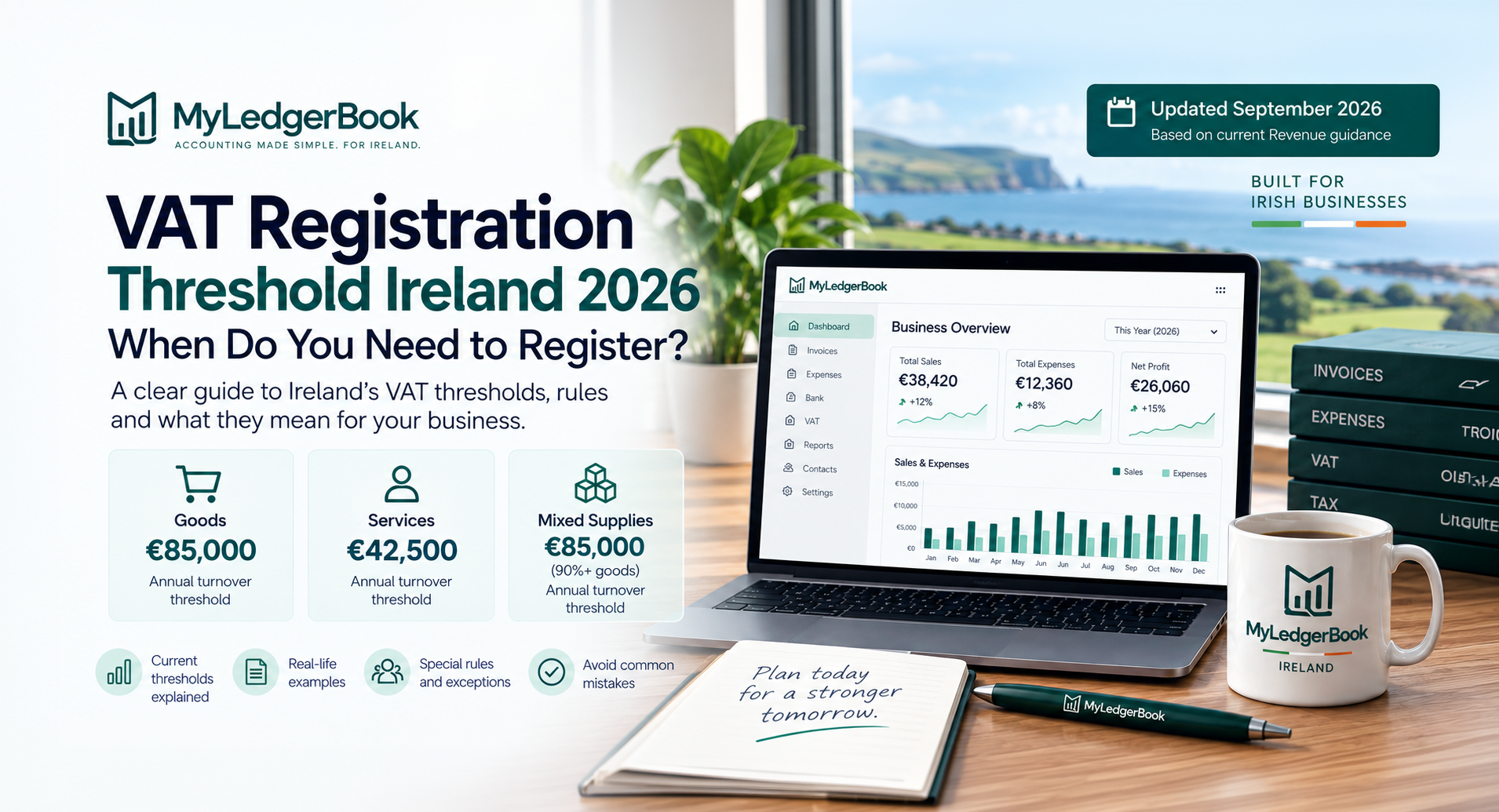
Quick answer: In 2026, the principal Irish VAT registration threshold is €42,500 for businesses supplying services only and €85,000 for businesses supplying goods. An €85,000 threshold can also apply to businesses supplying both goods and services where 90% or more of turnover comes from qualifying supplies of goods. Other VAT registration rules and thresholds can apply in particular circumstances.
What is the VAT registration threshold in Ireland in 2026?
For many Irish small businesses, the two figures to remember are:
€42,500 — services
€85,000 — goods
But those figures don't cover every situation.
According to current Revenue guidance, the principal VAT registration thresholds include:
| Type of business or transaction | VAT threshold |
|---|---|
| Services only | €42,500 |
| Goods only | €85,000 |
| Mixed goods and services where 90% or more of turnover is from qualifying supplies of goods | €85,000 |
| Certain goods manufactured or produced from zero-rated materials | €42,500 |
| Certain acquisitions of goods from other EU Member States | €41,000 |
| Certain intra-EU distance sales and cross-border TBE services | €10,000 |
These thresholds are not interchangeable, so it is important to identify which rules actually apply to your business.
What is the VAT threshold for services in Ireland?
Once registered, you'll also need to understand your ongoing VAT obligations. Our VAT3 Ireland guide explains the periodic VAT return, while our RTD Ireland guide covers the annual Return of Trading Details.
The principal VAT registration threshold for a business supplying services only is €42,500.
This can be particularly relevant to Irish sole traders and small businesses whose income mainly comes from their work rather than selling physical products.
Examples might include businesses such as:
- consultants
- designers
- photographers
- marketing businesses
- IT service providers
- business advisers
- repair and maintenance service providers
- other professional or service businesses
The nature of the actual supply matters. Don't assume your business falls under the services threshold simply because you think of yourself as a "service business".
What is the VAT threshold for goods in Ireland?
The principal VAT registration threshold for a business supplying goods is €85,000.
A straightforward example could be an Irish retailer selling physical products.
If its annual turnover from taxable goods exceeds the applicable €85,000 threshold, VAT registration generally becomes obligatory.
However, different rules can apply where goods and services are supplied together or where goods are manufactured or produced from zero-rated materials.
What if my business sells both goods and services?
This is where the rules become particularly important for tradespeople and other mixed businesses.
Revenue provides an €85,000 threshold for businesses supplying both goods and services where 90% or more of turnover comes from qualifying supplies of goods.
This means you should not automatically use the €85,000 goods threshold simply because you sometimes supply materials or products to customers.
Example: a tradesperson supplying labour and materials
Imagine an Irish tradesperson invoices customers for both labour and materials.
It may be tempting to say:
"I supply materials, so my VAT threshold is €85,000."
That conclusion may be wrong.
The correct threshold depends on the composition and nature of the business's supplies and whether the conditions for the higher mixed-supply threshold are satisfied.
This distinction can matter considerably as a business grows.
If your business combines substantial labour or services with goods, check the current Revenue rules or obtain professional advice rather than assuming the goods threshold applies.
Do I wait until I actually pass the threshold?
VAT registration is not something that should only be considered after discovering at year-end that turnover has already gone beyond the relevant level.
Revenue states that VAT registration is obligatory when annual turnover exceeds the applicable VAT threshold.
For businesses approaching their threshold, the practical lesson is simple:
keep an eye on turnover as the business grows.
If you're getting close to the applicable threshold, don't wait until your records are months behind before investigating your VAT position.
Good bookkeeping makes that much easier because you can see how the business is developing rather than trying to reconstruct turnover afterwards.
How is turnover calculated for the VAT threshold?
Revenue states that annual turnover for these purposes is calculated excluding VAT and can include the total value of:
- supplies of taxable goods and services
- supplies of immovable goods
- certain financial transactions
- insurance and reinsurance services
There are also transactions that may be excluded from the calculation.
For example, Revenue specifically identifies occasional disposals of business assets, such as buildings, vehicles or machinery, among the transactions excluded from annual turnover for this purpose.
Example: selling a business van
Revenue gives an example of a trader with €70,000 of goods sales who also sells a delivery van for €20,000 in a once-off transaction.
Simply adding those numbers would appear to produce €90,000 of turnover.
However, Revenue treats the sale of the van as an incidental disposal of a business asset for this calculation, leaving annual turnover of €70,000 for the relevant threshold purposes.
This illustrates why VAT-threshold turnover is not always as simple as looking at every payment received by the business and adding them together.
Can I register for VAT if I'm below the threshold?
Yes, in appropriate circumstances.
Revenue allows businesses below the VAT registration thresholds to elect to register voluntarily.
That means you don't necessarily have to wait until VAT registration becomes compulsory.
Once registered, however, VAT brings obligations as well as potential benefits.
A VAT-registered business may need to:
- charge VAT where applicable
- issue appropriate VAT invoices
- maintain VAT records
- submit VAT returns
- pay VAT due to Revenue
- comply with the relevant VAT rules
So voluntary registration should be a business decision rather than something done simply because having a VAT number appears more professional.
Why would a business voluntarily register for VAT?
There can be circumstances where voluntary VAT registration makes commercial sense.
For example, a business may have significant VAT-bearing business purchases or primarily sell to VAT-registered business customers.
Revenue also notes that a new business which has not yet begun supplying taxable goods or services may be able to reclaim VAT on start-up costs if it registers for VAT.
But voluntary registration isn't automatically beneficial for every small business.
A business selling mainly to private consumers may need to consider how charging VAT affects its prices or margins.
The right decision depends on the individual business.
Can voluntary VAT registration be backdated?
Revenue distinguishes an election to register voluntarily from some other registration circumstances.
Revenue's current guidance states that an election to register for VAT cannot be backdated and can only take effect from a current date.
Once you elect to register, the VAT obligations are generally the same as if you were required to register.
That makes it worth considering the decision before simply submitting a registration.
Can I cancel VAT registration later?
VAT registration can potentially be cancelled where circumstances change.
Revenue lists situations including where:
- the business has ceased trading
- turnover has fallen below the appropriate threshold
- registration occurred in error
- the nature of the business has changed and it is no longer making taxable supplies
However, businesses that voluntarily elected to register need to be particularly careful.
Revenue states that cancellation of an elected registration can result in recovery of certain VAT previously refunded, calculated under specific rules.
So voluntary VAT registration shouldn't be treated as a switch that can always be turned on and off without consequences.
What is the €41,000 EU acquisitions threshold?
There is another VAT threshold that can catch businesses that aren't otherwise VAT registered.
Revenue specifies a €41,000 threshold for certain acquisitions of goods from other EU Member States.
This can be relevant, for example, to certain exempt businesses and entities whose supplies are outside the scope of VAT.
Where applicable, registration can be required when qualifying intra-Community acquisitions exceed, or are likely to exceed, €41,000 in the relevant period.
This is separate from the normal €42,500 services and €85,000 goods thresholds.
What if I receive services from abroad?
This is an area where looking only at your normal turnover threshold can be misleading.
Revenue states that certain exempt and non-taxable persons receiving taxable services from abroad may have to register and account for Irish VAT irrespective of the value of those services.
Cross-border VAT rules can therefore create VAT obligations even where a business or organisation hasn't exceeded one of the headline domestic turnover thresholds.
If your business regularly buys services from suppliers outside Ireland, make sure you understand the VAT treatment that applies to those transactions.
What is the €10,000 EU distance-sales threshold?
Businesses selling across EU borders can encounter another threshold: €10,000.
This concerns certain intra-Community distance sales of goods and cross-border telecommunications, broadcasting and electronically supplied (TBE) services to consumers in other EU Member States.
The €10,000 threshold is not simply another Irish domestic VAT-registration threshold.
It relates to EU place-of-supply rules and is calculated across relevant cross-border supplies to customers in EU Member States.
Once the applicable threshold is exceeded, VAT may become due in the Member State where the customer is located, and mechanisms such as the One Stop Shop (OSS) may become relevant.
If you sell online to consumers elsewhere in the EU, this is an area worth checking carefully.
Do sole traders have a different VAT threshold?
Being a sole trader does not, by itself, create a separate general VAT turnover threshold.
What matters is the type of taxable supplies you make and the rules applying to those supplies.
For example, a sole trader providing services may fall under the €42,500 services threshold, while a sole trader selling goods may fall under the €85,000 goods threshold.
The legal structure of the business isn't the only thing that determines the threshold.
Does a limited company have a different VAT threshold?
Again, there isn't simply a special higher or lower general threshold because the business operates through a limited company.
The nature of the supplies and applicable VAT rules determine the relevant registration requirement.
A small limited company providing services can therefore encounter the same headline €42,500 services threshold that is relevant to a sole trader providing taxable services.
VAT threshold examples for Irish small businesses
The following simplified examples show why identifying the nature of the business matters.
Example 1: freelance consultant
A consultant provides taxable services to Irish businesses.
The relevant headline threshold for a services-only business is:
€42,500
If the consultant's turnover grows towards that level, VAT registration should be considered before it becomes a last-minute issue.
Example 2: online retailer
An Irish retailer sells physical goods to customers in Ireland.
The relevant headline goods threshold is:
€85,000
Different rules may arise if the retailer also makes cross-border sales to consumers elsewhere in the EU.
Example 3: tradesperson
A tradesperson supplies both labour and materials.
The answer cannot automatically be determined by choosing whichever threshold is more attractive.
The proportion and nature of the goods and services supplied matter, including whether the requirements for the €85,000 mixed-supply threshold are met.
Example 4: new business below the threshold
A new business expects turnover of €25,000 and is not otherwise required to register.
It may not be obliged to register under the normal turnover threshold, but it could consider voluntary registration if appropriate to its circumstances.
These examples are deliberately simplified. Actual VAT treatment depends on the facts of each business.
What changes once you become VAT registered?
Crossing a VAT threshold isn't simply an administrative registration.
VAT becomes part of the day-to-day bookkeeping of the business.
Depending on your circumstances, you'll need to correctly record:
Sales → VAT charged → T1
and qualifying:
Purchases and expenses → reclaimable VAT → T2
Those figures ultimately contribute to your VAT3 return.
You'll also need to consider appropriate VAT invoices, credit notes, VAT rates, EU transactions and filing deadlines where relevant.
This is why it is much easier to establish good VAT records when registration begins rather than trying to correct months of inconsistent bookkeeping later.
How do you register for VAT in Ireland?
Revenue provides online tax registration facilities through eRegistration.
ROS users can use eRegistration to register for VAT and other taxes where eligible.
Different procedures and forms apply in some circumstances, including for certain customers who aren't eligible for eRegistration and for businesses not established in Ireland.
Once VAT registered, Revenue requires VAT returns and payments to be made electronically.
Always use the current Revenue registration process applicable to your particular business.
Common VAT registration mistakes to avoid
Assuming every business has an €85,000 threshold
It doesn't.
For services-only businesses, the principal threshold is €42,500.
Confusing profit with turnover
The VAT threshold is based on relevant turnover, not the profit left after deducting business expenses.
A business can have relatively modest profit while still reaching its VAT registration threshold.
Assuming materials automatically make you a goods business
This can be particularly important for tradespeople.
Supplying some materials alongside labour doesn't automatically mean the €85,000 goods threshold applies.
Forgetting about EU transactions
Purchasing goods or services from abroad and selling to consumers elsewhere in the EU can bring additional VAT rules into play.
Registering voluntarily without considering the consequences
Voluntary VAT registration can be useful, but it also creates VAT compliance obligations and can affect pricing.
Waiting until the bookkeeping is months behind
If you don't know your current turnover, it becomes much harder to know when you're approaching a VAT threshold.
Keeping records current gives you time to prepare.
How MyLedgerBook helps you stay on top of VAT
MyLedgerBook is accounting software built specifically for Irish businesses.
As you create invoices and record business transactions, your records give you a clearer picture of how the business is performing and help you keep the information needed for Irish VAT organised.
Once you're VAT registered, MyLedgerBook can use the invoices and expenses you've recorded to prepare the figures behind your Irish VAT position.
Instead of treating VAT as something to reconstruct just before a deadline, the aim is to let your bookkeeping build the figures as you go.
Record it once. Keep the Irish accounting figures organised around it.
Start using MyLedgerBook
Create invoices, record expenses and keep your Irish business finances organised in one place.
Free during Early Access · No credit card required
VAT Registration Threshold Ireland: Frequently Asked Questions
What is the VAT threshold in Ireland in 2026?
The principal VAT registration thresholds are €42,500 for businesses supplying services only and €85,000 for businesses supplying goods. Other thresholds and rules apply to particular types of supplies and cross-border transactions.
What is the VAT threshold for a sole trader in Ireland?
There isn't one separate general threshold specifically for sole traders. The applicable threshold depends primarily on what the business supplies. A services-only sole trader may have a €42,500 threshold, while the principal threshold for a business supplying goods is €85,000.
What is the VAT threshold for services in Ireland?
The principal VAT registration threshold for persons supplying services only is €42,500.
What is the VAT threshold for goods in Ireland?
The principal VAT registration threshold for persons supplying goods is €85,000.
What is the VAT threshold if I sell goods and services?
An €85,000 threshold can apply where a business supplies both goods and services and 90% or more of turnover comes from qualifying supplies of goods. Mixed businesses should check that they actually meet the relevant conditions rather than automatically assuming the higher threshold applies.
Can I register for VAT before reaching the threshold?
Yes. Eligible businesses below the compulsory registration threshold can elect to register voluntarily for VAT.
Is the VAT threshold based on profit?
No. The threshold concerns relevant turnover, not the business's profit after expenses.
Do I need to register for VAT if I buy services from abroad?
Special rules can apply. Certain exempt or non-taxable persons receiving taxable services from abroad can be required to register and account for VAT regardless of the value of those services.
What happens after I register for VAT?
VAT registration brings ongoing responsibilities, which can include charging VAT, issuing appropriate VAT invoices, keeping VAT records and filing and paying VAT electronically.
Official sources and further reading
This guide has been checked against current guidance from the Irish Revenue Commissioners.
- Revenue — VAT registration thresholds
- Revenue — Who should register for VAT?
- Revenue — Who may elect to register for VAT?
- Revenue — Goods or services acquired from abroad
- Revenue — How do you register for VAT?
- Revenue — Cancelling your VAT registration
Last reviewed: 7 September 2026
This guide provides general information for Irish businesses and is not tax, legal or professional accounting advice. VAT registration and VAT treatment depend on the nature of your business and individual transactions. Always check current Revenue guidance or seek professional advice where appropriate.