
VAT3 Ireland: A Simple Guide for Small Businesses (2026)
· By MyLedgerBook Editorial Team
Updated September 2026
Updated: September 2026 · Based on current Revenue guidance
If you're VAT registered in Ireland, the VAT3 is one of the most important tax returns you'll deal with. But terms such as T1, T2, T3 and T4 can make a relatively simple calculation look more complicated than it needs to be.
If you're unsure whether your business needs to be VAT registered, see our VAT Registration Threshold Ireland 2026 guide.
This guide explains what a VAT3 is, when it is due, what the main boxes mean and how to keep the records you need throughout the year.
Quick answer: A VAT3 is the return used by VAT-registered businesses in Ireland to report VAT payable or reclaimable for a taxable period. T1 records VAT on sales and certain other transactions, T2 records VAT you're entitled to reclaim, and the difference results in either VAT payable at T3 or VAT repayable at T4.
What is a VAT3 return in Ireland?
A VAT3 is the periodic Value-Added Tax return used by VAT-registered businesses in Ireland.
It tells Revenue how much VAT is payable by your business or, where applicable, how much VAT may be reclaimable for the taxable period.
For many small businesses, the basic calculation can be thought of as:
VAT due on sales and relevant transactions (T1) − reclaimable VAT (T2) = VAT payable (T3)
If the amount you're entitled to reclaim at T2 is greater than T1, the difference is shown as VAT repayable at T4 instead.
Your VAT3 may also contain additional boxes covering EU transactions and imports under Postponed Accounting.
VAT3 boxes explained: T1, T2, T3 and T4
The four boxes most small businesses will want to understand first are T1, T2, T3 and T4.
T1 — VAT on sales
T1 is the total VAT due for the period.
This can include VAT due on:
- supplies of goods and services
- intra-EU acquisitions of goods
- imports where Postponed Accounting has been applied
- certain services received by the business
For a straightforward Irish business selling VATable goods or services, VAT charged on sales will normally form an important part of the T1 figure.
T2 — VAT on purchases
T2 is the VAT that you're entitled to reclaim on qualifying business costs.
Depending on the circumstances, this can include VAT relating to:
- qualifying goods and services used for taxable supplies
- intra-EU acquisitions
- imports using Postponed Accounting
- certain services received
- the flat-rate addition where applicable
Not every expense automatically gives you a right to reclaim VAT. The expense and the VAT must qualify under the applicable rules.
T3 — VAT payable
If T1 is greater than T2, your business owes Revenue the difference.
For example:
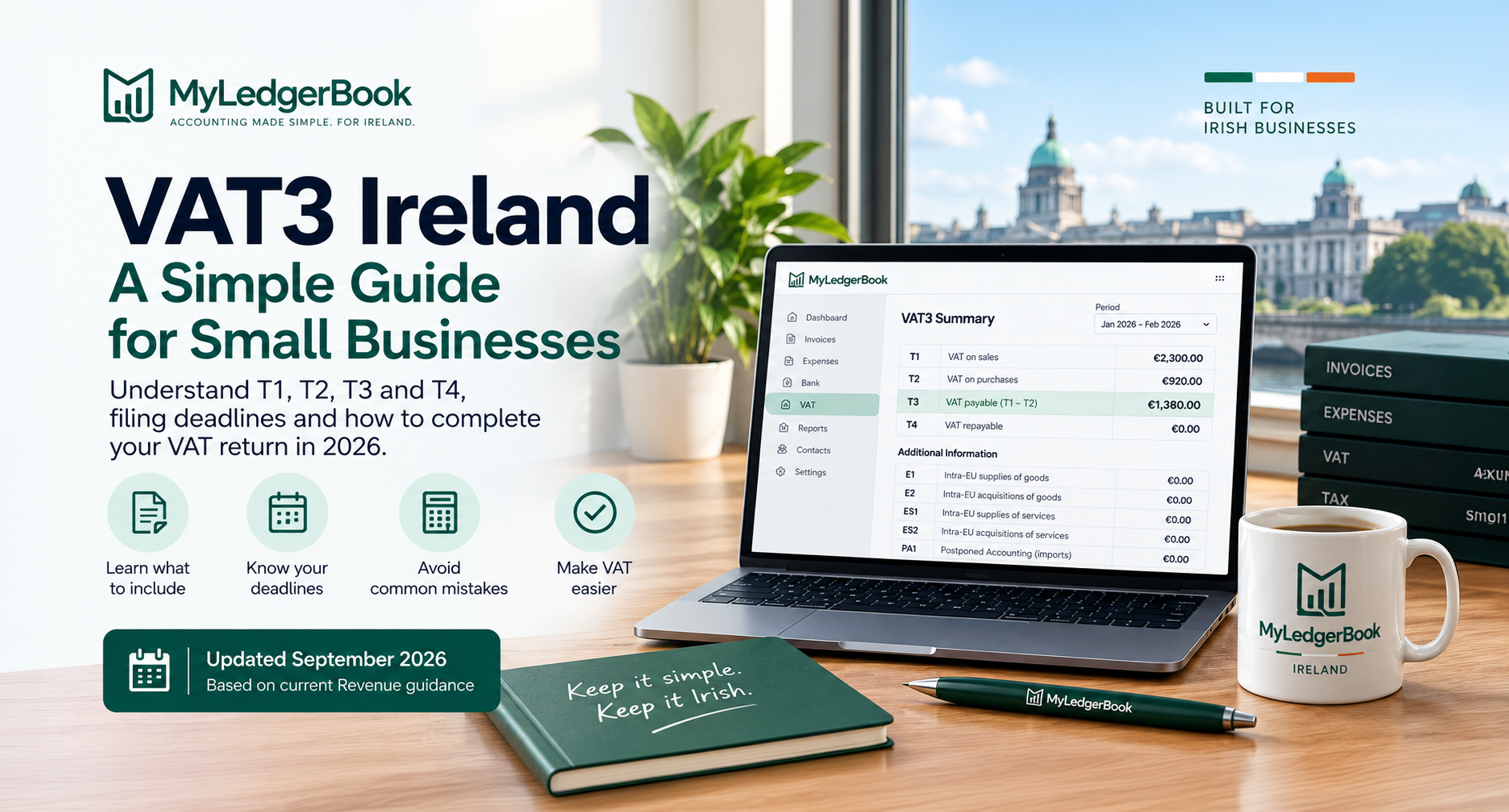
T1 — VAT due: €2,300
T2 — VAT reclaimable: €920
T3 — VAT payable: €1,380
So in this example, the VAT3 would show €1,380 payable.
T4 — VAT repayable
If T2 is greater than T1, the difference is instead entered at T4 as VAT repayable.
For example:
T1: €1,000
T2: €1,350
T4: €350
Revenue notes that a VAT repayment can be withheld where there are outstanding tax returns, so a T4 amount does not necessarily mean an immediate payment in every circumstance.
VAT3 at a glance
| VAT3 box | What it represents |
|---|---|
| T1 | VAT due on sales and certain other transactions |
| T2 | VAT you're entitled to reclaim |
| T3 | VAT payable when T1 is greater than T2 |
| T4 | VAT repayable when T2 is greater than T1 |
| E1 | Value of goods supplied to customers in other EU countries |
| E2 | Value of goods acquired from suppliers in other EU countries |
| ES1 | Value of services supplied to customers in other EU countries |
| ES2 | Value of services received from suppliers in other EU countries |
| PA1 | Relevant value of imports where Postponed Accounting is used |
The E1, E2, ES1, ES2 and PA1 fields become particularly important for businesses trading internationally.
When is a VAT3 due in Ireland?
The standard VAT taxable period in Ireland is generally two months.
These bi-monthly periods begin in:
- January
- March
- May
- July
- September
- November
Revenue states that VAT must normally be filed and paid by the 19th day of the month following the end of the taxable period.
For businesses filing and paying through Revenue Online Service (ROS), the deadline is generally extended to the 23rd day of that month.
For example, the July–August 2026 VAT3 is due on 19 September under the standard deadline, with the ROS filing/payment deadline extending to 23 September where the relevant ROS conditions are met.
Always check your own Revenue obligations and the current Revenue calendar rather than assuming every business has the same filing date.
Does every business file VAT every two months?
Not necessarily.
While two months is the standard taxable period, Revenue may authorise different filing periods.
According to current Revenue guidance:
- businesses with an annual VAT liability between €3,001 and €14,400 may be authorised to file every four months
- businesses with an annual VAT liability between €1 and €3,000 may be authorised to file every six months
- businesses that are consistently in a VAT repayment position may, in some circumstances, be authorised to file monthly returns
Your actual filing frequency is determined by Revenue, so check your ROS account if you're unsure.
What if there is no VAT to pay?
You may still have to file the VAT3.
Revenue states that where there is no VAT payable or repayable for the period, the VAT3 should be returned with zero entered at T1, T2, T3 and T4.
In other words, having no VAT payment to make does not necessarily mean there is no return to file.
How do you prepare a VAT3?
The easiest way to prepare a VAT3 is not to wait until the filing deadline to start working out what happened during the previous two months.
Good VAT records should be built as you run the business.
In practical terms, that means keeping your sales invoices, purchases and expenses properly recorded and applying the correct VAT treatment when transactions are entered.
When the VAT period ends, you can then calculate the VAT due and reclaimable from records that are already organised.
A typical process looks like this:
- Record all sales for the VAT period.
- Record qualifying purchases and expenses.
- Check that the appropriate VAT treatment has been applied.
- Review any credit notes or adjustments.
- Identify relevant EU transactions or imports.
- Calculate T1 and T2.
- Calculate whether the difference is payable at T3 or repayable at T4.
- Review the figures before submitting the VAT3 through ROS.
What about credit notes?
Credit notes can affect the VAT figures for a period.
Revenue states that where you issue or receive a credit note, the relevant T1 and T2 figures may be adjusted.
This is one reason accurate bookkeeping matters: an invoice that was cancelled, reduced or credited should not simply remain in your VAT records as though nothing changed.
What do E1, E2, ES1 and ES2 mean?
These boxes deal with certain transactions between your Irish business and businesses in other EU Member States.
E1 — Intra-EU supplies of goods
E1 records the total value of goods sent to customers in other EU countries.
E2 — Intra-EU acquisitions of goods
E2 records the total value of goods received from suppliers in other EU countries.
ES1 — Intra-EU supplies of services
ES1 records the total value of services supplied to customers in other EU countries.
ES2 — Intra-EU acquisitions of services
ES2 records the total value of services received from suppliers in other EU countries.
EU VAT rules can become more complex depending on the transaction and customer, so businesses trading across borders should make sure the correct VAT treatment applies.
What is PA1 on a VAT3?
PA1 relates to Postponed Accounting for imports.
Revenue defines PA1 as the Customs value of goods imported under Postponed Accounting, as shown on the relevant Customs Declarations, plus Customs Duty.
If your business imports goods and uses Postponed Accounting, make sure those transactions are recorded correctly rather than treating them as ordinary domestic purchases.
A simple VAT3 example
Imagine an Irish VAT-registered business has the following figures for a taxable period:
Sales
VAT due for the period: €2,300
Purchases and expenses
Qualifying VAT reclaimable: €920
The calculation is:
€2,300 − €920 = €1,380
The VAT3 would therefore show:
| Box | Amount |
|---|---|
| T1 | €2,300 |
| T2 | €920 |
| T3 | €1,380 |
| T4 | €0 |
The business would normally have €1,380 VAT payable for that period, subject to any other relevant VAT3 entries or adjustments.
Common VAT3 mistakes small businesses should avoid
Leaving bookkeeping until the VAT deadline
Trying to reconstruct two months of sales, purchases and receipts just before the VAT3 is due increases the chance of missing transactions or making mistakes.
Keeping records up to date throughout the period makes VAT preparation much easier.
Assuming every expense means reclaimable VAT
An expense being a legitimate business cost does not automatically mean all VAT on it can be reclaimed.
VAT deductibility has its own rules.
Using the wrong VAT rate
Different goods and services can be subject to different VAT rates. Applying the wrong rate affects the VAT collected and ultimately the VAT3 figures.
Forgetting credit notes
Credit notes can change T1 or T2 and should be reflected correctly in the relevant VAT period.
Ignoring EU transactions
If your business buys from or sells to businesses elsewhere in the EU, additional VAT rules and VAT3 fields may apply.
Missing the filing deadline
Revenue states that late or non-filing and payment of VAT may result in interest and penalties.
A simple deadline reminder can therefore be worth considerably more than the few minutes it takes to set one.
VAT3 and the Return of Trading Details (RTD) are not the same thing
VAT3 and RTD are related, but they are different returns.
A VAT3 reports VAT payable or reclaimable for a particular taxable period.
The Return of Trading Details (RTD) is an annual return that provides details of total purchases and sales for the year, broken down by VAT rate.
This is another reason consistent VAT records throughout the year matter. If transactions and VAT rates have been recorded properly as you go, preparing annual VAT information becomes much easier.
For the annual VAT requirement, see our RTD Ireland guide, which explains the Return of Trading Details, what it contains and when it is due.
How MyLedgerBook makes VAT3 preparation easier
MyLedgerBook is accounting software built specifically for Irish businesses.
Instead of waiting until your VAT deadline and trying to reconstruct your figures, you record the invoices and expenses that already form part of running your business.
MyLedgerBook uses those records to prepare your Irish VAT figures as you go.
That means you can see the figures behind your VAT position, review them and use them when completing your VAT obligations through ROS.
For small-business owners who don't want to spend their evenings working through spreadsheets and receipts, the aim is simple:
Do the bookkeeping once. Let the figures build from it.
Start using MyLedgerBook
Create invoices, record expenses and keep your Irish VAT figures organised in one place.
Free during Early Access · No credit card required
VAT3 Ireland: Frequently Asked Questions
What is a VAT3 in Ireland?
A VAT3 is the VAT return used by VAT-registered businesses in Ireland to report VAT payable or reclaimable for a taxable period.
What is T1 on a VAT3?
T1 represents VAT due for the period. This includes VAT on supplies of goods and services and can also include VAT relating to certain EU acquisitions, imports using Postponed Accounting and received services.
What is T2 on a VAT3?
T2 represents VAT that the business is entitled to reclaim on qualifying costs and certain other transactions.
What is T3 on a VAT3?
T3 is the VAT payable to Revenue when T1 is greater than T2. It is the difference between the two figures.
What is T4 on a VAT3?
T4 is the VAT repayable where T2 is greater than T1. It is the difference between those figures.
How often do you file VAT3 in Ireland?
The standard taxable period is two months, although Revenue may authorise monthly, four-monthly or six-monthly filing in certain circumstances.
What is the ROS deadline for VAT3?
Revenue states that VAT must normally be filed and paid by the 19th day of the month following the taxable period. For ROS filers, the filing deadline is generally extended to the 23rd.
Do I need to file a VAT3 if I have no VAT to pay?
A zero VAT liability does not necessarily remove the filing obligation. Revenue states that where no VAT is payable or repayable, the VAT3 should be returned with zero entered in T1, T2, T3 and T4.
Is VAT3 the same as RTD?
No. VAT3 is a periodic VAT return. The Return of Trading Details is an annual return detailing purchases and sales broken down by VAT rate.
Official sources and further reading
This guide has been checked against current guidance from the Irish Revenue Commissioners.
- Revenue — How do you complete a VAT3 return?
- Revenue — When VAT becomes payable
- Revenue — VAT accounting overview
- Revenue — Tax calendar
Last reviewed: 7 September 2026
This guide provides general information for Irish businesses and is not tax, legal or professional accounting advice. VAT treatment depends on the nature of your business and individual transactions. Always check current Revenue guidance or seek professional advice where appropriate.