VAT Invoice Requirements Ireland: What Must Be on an Invoice? (2026)
· By MyLedgerBook Editorial Team
Updated September 2026 · Based on current Revenue guidance
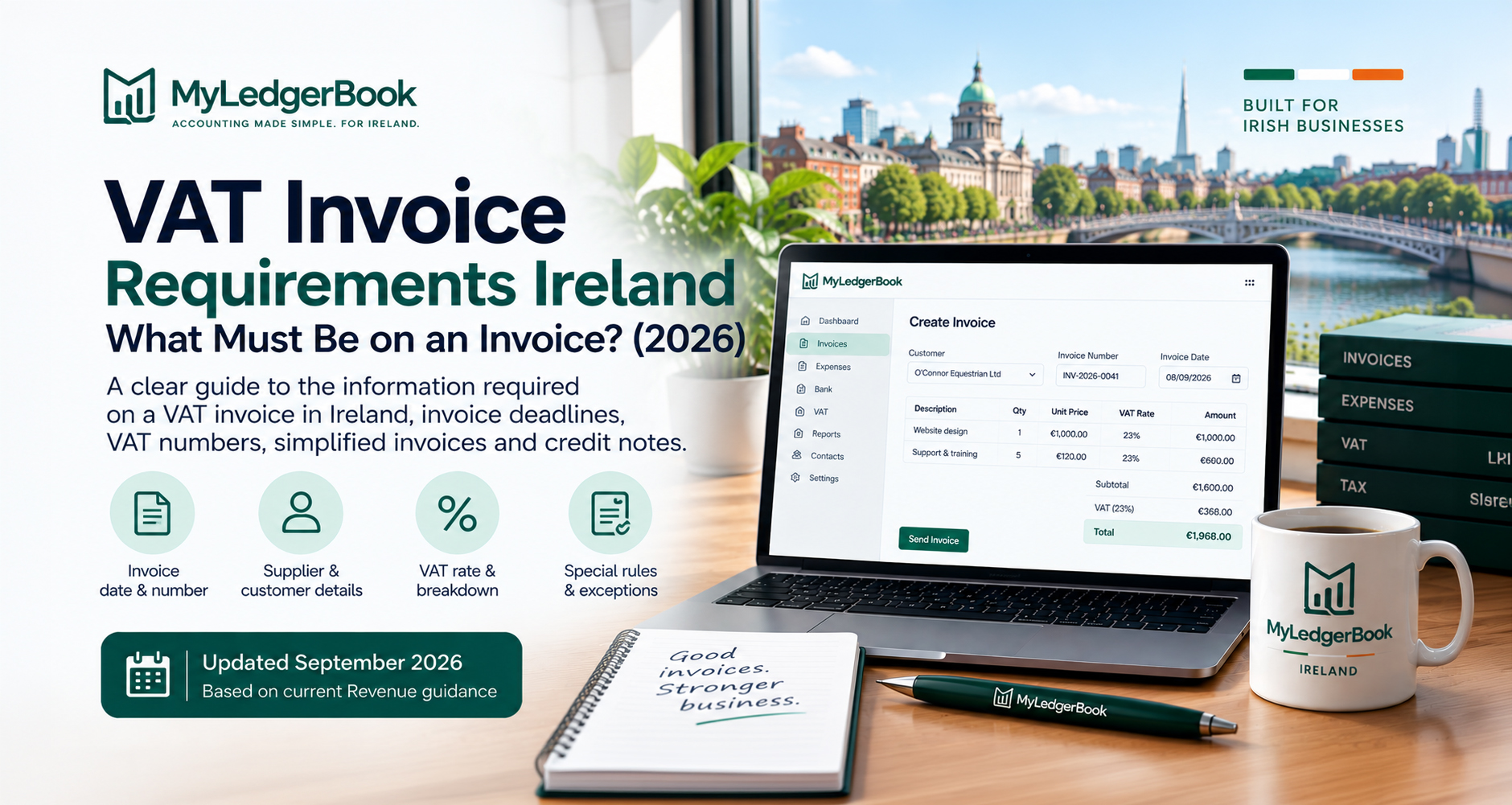
If you're VAT registered in Ireland, an invoice is more than a request for payment. It is also an important VAT record.
Revenue specifies information that must appear on a VAT invoice, including invoice dates, unique sequential numbers, supplier and customer details, VAT information and details of the goods or services supplied.
Getting those details right from the beginning makes your bookkeeping, VAT returns and customer records much easier to manage.
Quick answer: An Irish VAT invoice generally needs a date of issue, a unique sequential invoice number, the supplier's full name, address and VAT registration number, the customer's full name and address, details of the goods or services, VAT-exclusive prices, the applicable VAT rates and the total VAT payable. Additional information is required for certain transactions.
What is a VAT invoice in Ireland?
Revenue describes a VAT invoice as a document issued by an accountable person which sets out the details of a taxable supply and the information required under VAT law.
For a VAT-registered business, the invoice serves two important purposes.
For the supplier, it helps establish the VAT liability arising from the sale.
For a VAT-registered customer, a valid VAT invoice can provide the documentary basis for reclaiming VAT where the normal conditions for deductibility are satisfied.
That is why a VAT invoice needs more information than simply:
"Website design — €1,000"
A proper VAT invoice needs to identify the transaction, supplier, customer and VAT treatment clearly.
What must be included on a VAT invoice in Ireland?
Revenue's current guidance lists the information required on a VAT invoice.
Depending on the transaction, a VAT invoice should include:
- the date of issue
- a unique sequential invoice number
- the supplier's full name
- the supplier's address
- the supplier's VAT registration number
- the customer's full name
- the customer's address
- the quantity and nature of goods supplied, where applicable
- the extent and nature of services supplied, where applicable
- the VAT-exclusive unit price
- relevant discounts or price reductions
- a breakdown by VAT rate
- the total VAT payable
- the date the goods or services were supplied
- where applicable, the date of an advance payment if different from the invoice date
Certain transactions require additional information.
These include reverse-charge transactions, intra-Community supplies, triangulation and some special VAT schemes.
What does a compliant VAT invoice look like?
Imagine an Irish VAT-registered business supplies a service to another Irish business.
A simplified example might contain:
Supplier: Example Services, Dublin, Ireland
VAT number: IE1234567X
Customer: Sample Business Ltd, Cork, Ireland
Invoice number: INV-2026-0041
Invoice date: 8 September 2026
Supply date: 8 September 2026
Service: Website maintenance services
Price excluding VAT: €1,000.00
VAT at 23%: €230.00
Total: €1,230.00
The actual requirements depend on the transaction, but this illustrates the basic structure.
The important point is that the invoice makes it clear:
who supplied what, to whom, when, for how much and how VAT was calculated.
Does every invoice need a unique invoice number?
For a VAT invoice, Revenue requires a unique sequential number.
A sensible numbering system might therefore look like:
INV-2026-0001
INV-2026-0002
INV-2026-0003
and so on.
The exact visual format isn't the important part.
What matters is maintaining a clear sequence that uniquely identifies each invoice.
A consistent numbering system also makes it much easier to locate a transaction later when dealing with:
- customer queries
- payments
- bookkeeping
- VAT returns
- credit notes
- accountant queries
- Revenue records
Does my VAT number need to be on the invoice?
Yes. Revenue includes the supplier's VAT registration number among the information required on a VAT invoice.
That is different from simply displaying a business name or company registration number.
If you're unsure whether your business should be VAT registered in the first place, see our VAT Registration Threshold Ireland guide.
Once registered for VAT, your invoicing and bookkeeping need to reflect your VAT obligations correctly.
Do I need the customer's VAT number on every invoice?
Not necessarily.
Revenue's general list requires the customer's full name and address, while the customer's VAT number becomes specifically important for particular transactions.
For example, additional requirements apply where:
- a reverse charge applies
- there is an intra-Community supply of goods
- EC triangulation rules apply
For an intra-Community supply of goods, Revenue requires the customer's VAT number and a notation identifying the transaction as an intra-Community supply of goods.
So don't assume the same invoice wording applies to every domestic and cross-border sale.
Do I need to show VAT separately?
A standard VAT invoice needs to contain sufficient information to show how VAT has been calculated.
Revenue requires information including:
- VAT-exclusive pricing
- the breakdown by VAT rate
- total VAT payable
If more than one VAT rate applies to an invoice, the amounts need to be broken down appropriately.
This is one reason invoicing software is useful for VAT-registered businesses: the VAT treatment can be recorded when the invoice is created rather than reconstructed later.
Those sales records ultimately contribute to your VAT calculations.
Our VAT3 Ireland guide explains how sales VAT feeds into the figures used for your VAT3 return.
Which VAT rate should I put on an invoice?
The correct VAT rate depends on the goods or services being supplied.
Ireland currently has several VAT rates and treatments, so you shouldn't simply use 23% for every taxable transaction.
The appropriate rate depends on the particular supply.
If you're unsure which VAT rate applies, check Revenue's current VAT rate guidance rather than guessing.
Using the wrong VAT rate can cause problems both for your own VAT liability and for customers attempting to reclaim VAT.
When must a VAT invoice be issued?
Revenue's current guidance states that a VAT invoice must generally be issued within 15 days of the end of the month in which the goods or services are supplied.
For example, if a qualifying supply is made during September, the VAT invoice would generally need to be issued no later than 15 October.
That doesn't mean you should routinely wait until the deadline.
For most small businesses, issuing the invoice promptly after the work is completed or goods are supplied is better for both bookkeeping and cash flow.
The sooner the customer receives the invoice, the sooner the payment process can begin.
What if the customer pays a deposit or advance?
Special VAT invoicing rules apply where payment is received before the goods or services are supplied.
Revenue states that where a payment is received in full or in part before completion of the supply, a VAT invoice generally needs to be issued in respect of each payment.
The invoice must generally be issued no later than the 15th day of the month following the month in which the payment was received.
Revenue notes that this rule does not apply in the same way to intra-Community supplies of goods, and special rules can apply to deposits.
This is particularly relevant to businesses that use:
- deposits
- staged payments
- progress payments
- advance retainers
- booking payments
Good invoicing records should make it clear which payment relates to which transaction.
Who must issue a VAT invoice?
Revenue requires an accountable person to issue a VAT invoice for supplies to certain customers.
These include supplies to:
- another accountable person
- a Department of State
- a local authority
- a body established by statute
- a person carrying on an exempt activity
- certain persons in another EU Member State
- persons in another Member State where a reverse charge applies
Special rules also apply to certain intra-Community distance sales.
Whether a formal VAT invoice is required therefore depends partly on the nature of the customer and transaction.
Do I need to issue a VAT invoice to every private customer?
The general VAT invoicing rules distinguish between different types of customers and transactions.
An accountable person is required to issue VAT invoices in the circumstances specified by Revenue, including supplies to other accountable persons and various other bodies and cross-border customers.
This doesn't mean that every ordinary retail sale to a private consumer necessarily requires the same full VAT invoice.
However, businesses still need appropriate sales records and may have other obligations to provide receipts or documentation.
Your invoicing setup should therefore reflect the type of customers your business actually serves.
What is a simplified VAT invoice?
Revenue allows a simplified invoice in certain circumstances.
One important case is where the invoice amount is not greater than €100.
Simplified invoices may also be permitted where commercial, technical or administrative practices in a particular business sector make compliance with the general invoice requirements difficult.
A simplified invoice should include:
- date of issue
- supplier's full name
- supplier's address
- supplier's VAT registration number
- description of the goods or services
- tax payable or the price exclusive of tax
A simplified invoice cannot be used for intra-Community supplies of goods or services.
Can I send VAT invoices electronically?
Yes.
Revenue permits electronic invoicing subject to certain conditions.
Electronic invoicing arrangements need to preserve the integrity of the records, provide an appropriate audit trail and allow the relevant records to be retained, retrieved and reproduced.
Revenue's current guidance also states that electronic invoicing is subject to agreement between the parties.
For many Irish small businesses, sending a PDF invoice electronically is already a normal part of doing business.
However, there is an important distinction between today's electronic invoicing rules and the more structured eInvoicing systems that are planned under Ireland's VAT modernisation programme.
Are PDF invoices being replaced by eInvoicing?
Not immediately, but Irish businesses should be aware that VAT invoicing is changing.
Revenue has announced a programme to implement structured eInvoicing and digital VAT reporting in Ireland as part of wider EU VAT modernisation.
These future structured eInvoices are not simply PDFs sent by email.
Revenue's implementation plans indicate that mandatory changes will be introduced over a number of phases in the coming years.
For a small Irish business operating in 2026, however, the important task today is still to comply with the current invoicing rules.
We will update this guide as Ireland's mandatory eInvoicing requirements come closer and the final practical requirements for small businesses become relevant.
What happens if I make a mistake on a VAT invoice?
Don't simply ignore an incorrect VAT invoice.
Revenue provides procedures for correcting invoices.
If the price on an invoice needs to be increased, a supplementary invoice may be required.
If the price is reduced, a credit note may be required.
The correction becomes particularly important where the wrong amount of VAT was shown.
Revenue states that if an invoice shows more VAT than was actually correct, the supplier remains liable for the VAT shown until the matter is corrected using the appropriate credit-note and revised-invoice procedure.
Accurate VAT invoices therefore protect both you and your customer.
What is a VAT credit note?
A VAT credit note is used to reflect certain reductions or corrections to an amount that was previously invoiced.
For example, a credit note may be needed where:
- the original price is reduced
- a discount or allowance changes the original amount
- the VAT rate on the original invoice was incorrect
Revenue requires a VAT credit note to contain information including:
- date of issue
- unique number
- supplier details and VAT number
- customer details
- reason for the credit note
- reference to the original invoice
- amended consideration
- applicable VAT rate or rates
- VAT amount at each rate
Credit notes are not merely negative invoices that can be created without reference to the original transaction.
They form part of your VAT records.
How do invoices affect your VAT3?
Your invoices form part of the records behind your VAT calculations.
For a VAT-registered business, VAT charged on taxable sales contributes to the output VAT reported through the VAT3 process.
VAT on qualifying purchases may contribute to the amount deductible, subject to the normal rules.
Our VAT3 Ireland guide explains the T1, T2, T3 and T4 figures in more detail.
The important bookkeeping principle is:
Your VAT return should come from your transaction records — not from trying to remember your sales and expenses when the VAT deadline arrives.
How do invoices affect your annual RTD?
Your sales records are also important when preparing the annual Return of Trading Details.
Revenue requires sales records to be separated into the different VAT rates, including exempt transactions.
That means recording the correct VAT rate when the invoice is created can make annual RTD preparation much easier.
Our RTD Ireland guide explains what the annual Return of Trading Details contains and when it is due.
This illustrates how the same properly recorded invoice can support several parts of your accounting:
Invoice → sales records → VAT3 → annual RTD
Good bookkeeping starts with getting the original transaction right.
How long should VAT invoices be kept?
Revenue requires businesses to keep full and accurate VAT records.
Those records include documents such as:
- invoices
- credit notes
- debit notes
- receipts
- accounts
- bank statements
- relevant VIES records
- relevant import documentation
For businesses generally, Revenue requires tax records to be retained for the applicable statutory period, which is commonly six years.
Our Sole Trader Accounting Ireland guide explains the broader record-keeping responsibilities for Irish sole traders.
What purchase invoice information should I record?
Invoices you receive from suppliers are just as important as invoices you send to customers.
Revenue's current guidance says purchase records should include information such as:
- date of the purchase invoice
- supplier name
- cost excluding VAT
- VAT charged
- purchases separated by VAT rate
Purchases of goods intended for resale should also be recorded separately from goods or services not intended for resale, and imports and intra-Community acquisitions should be identifiable.
This information helps support any VAT deduction you're entitled to claim.
Common VAT invoice mistakes to avoid
Leaving off your VAT registration number
If you're issuing a VAT invoice, your VAT registration number is one of the required supplier details.
Using duplicate invoice numbers
VAT invoices should have unique sequential numbers.
Using the wrong VAT rate
Don't assume every taxable supply uses the standard rate.
Showing only a VAT-inclusive total
A standard VAT invoice needs the appropriate VAT breakdown rather than simply displaying one unexplained total.
Forgetting the customer's details
The customer's full name and address form part of the general VAT invoice requirements.
Using a simplified invoice when it isn't allowed
The simplified-invoice rules are limited and cannot be used for intra-Community supplies of goods or services.
Deleting an invoice when something changes
Where an invoice needs correcting, use the appropriate supplementary invoice, credit note or revised invoice procedure rather than destroying the accounting trail.
Losing purchase invoices
Purchase invoices help support VAT deductions and your wider business expenses.
Creating invoices separately from your bookkeeping
If an invoice is created in one system and then manually entered again into another, you create additional work and opportunities for mistakes.
Ideally, creating the invoice should also create the underlying accounting record.
A practical invoice checklist for Irish businesses
Before sending a standard VAT invoice, check:
- Is the invoice number unique and sequential?
- Is the invoice date shown?
- Are your business name and address correct?
- Is your VAT registration number included?
- Is the customer's full name shown?
- Is the customer's address shown?
- Are the goods or services clearly described?
- Is the relevant supply date included?
- Are VAT-exclusive amounts clear?
- Is the correct VAT rate being used?
- Is VAT correctly calculated?
- Is the total VAT payable shown?
- Are any required reverse-charge or intra-Community references included?
Getting these details right when creating the invoice is much easier than correcting them afterwards.
How MyLedgerBook helps with Irish invoicing
MyLedgerBook is accounting and invoicing software built specifically for Irish businesses.
You can create professional invoices while keeping the transaction connected to the rest of your business records.
Instead of invoicing being separate from accounting, the invoice becomes part of your bookkeeping.
That means the same records can help you:
- keep track of sales
- see paid and unpaid invoices
- record VAT correctly
- prepare VAT figures
- keep customer records organised
- prepare the information needed for VAT3 and RTD
- understand how the business is performing
MyLedgerBook also supports deposit and staged invoices, which can be particularly useful for tradespeople and other businesses that don't simply invoice the entire job at the end.
For VAT-registered businesses, the transactions you've recorded help MyLedgerBook prepare your VAT figures.
MyLedgerBook does not file VAT returns with Revenue on your behalf.
You review the figures and complete the appropriate Revenue obligations through ROS.
Start creating your invoices
Create professional invoices, record expenses and keep the accounting behind your Irish business organised in one place.
Free during Early Access · No credit card required
VAT Invoice Requirements Ireland: Frequently Asked Questions
What must be on a VAT invoice in Ireland?
A standard VAT invoice generally needs a unique sequential number, issue date, supplier name and address, supplier VAT number, customer name and address, details of the goods or services, VAT-exclusive pricing, applicable VAT rates, total VAT payable and relevant supply dates. Additional information applies to certain transactions.
Does my VAT number have to be on my invoices?
Yes. The supplier's VAT registration number is one of Revenue's required details for a VAT invoice.
Does an invoice need a unique number?
Yes. Revenue requires a VAT invoice to contain a unique sequential number.
How quickly must a VAT invoice be issued?
Revenue states that a VAT invoice must generally be issued within 15 days of the end of the month in which the goods or services were supplied.
What is a simplified VAT invoice?
A simplified invoice can be used in certain circumstances, including where the invoice amount is not greater than €100. It contains fewer required details than a standard VAT invoice but cannot be used for intra-Community supplies of goods or services.
Can I email a VAT invoice?
Revenue permits invoices to be issued electronically subject to its electronic-invoicing conditions.
What happens if I put the wrong VAT rate on an invoice?
Revenue provides correction procedures involving credit notes and revised invoices. Don't simply alter or delete an incorrect VAT invoice without maintaining the proper accounting record.
Do I need to keep copies of invoices?
VAT-registered businesses need to maintain adequate records supporting their VAT transactions, including invoices and related documents.
Do invoices affect my VAT3?
Yes. Your sales and purchase records provide the underlying information used to calculate your VAT position. See our VAT3 Ireland guide for a detailed explanation.
Official sources and further reading
This guide has been checked against current guidance from the Irish Revenue Commissioners.
- Revenue — What is a VAT invoice?
- Revenue — Who must issue a VAT invoice?
- Revenue — Information required on a VAT invoice
- Revenue — Other types of VAT invoices
- Revenue — Amending a VAT invoice
- Revenue — Advance payments and VAT invoices
- Revenue — Keeping VAT records
Last reviewed: 8 September 2026
This guide provides general information for Irish businesses and is not tax, legal or professional accounting advice. VAT invoicing requirements can vary according to the transaction and circumstances. Always check current Revenue guidance or seek professional advice where appropriate.